

Your Life Is a Feedback Loop
Shifting your stuck patterns from a closed loop to an open spiral

Every day invisible feedback loops are shaping your mood, your decisions, your relationships, and what feels possible to you. You have been living inside them your entire life, and no one told you. When you understand what’s going on, you can better exercise agency and begin to truly steer not only your own life, but the systems you belong to.
You hadn’t yet consciously registered that something was off, but your body was already responding. Heart rate, muscle tension, breath depth, hormonal state, all of it shifting in the direction of threat or safety, contraction or openness, before a single conscious thought formed. By the time you decided how you felt, your physiology had already voted on what to do next.
This happens thousands of times a day. The implication is that what most people call their thoughts, their moods, their decisions, their personality, is often the downstream result of physiological processes they never learned to see.
Many people spend enormous energy, time, and money trying to change their behavior, their relationships, and their results while the feedback loops actually generating those outcomes continue running beneath awareness, unexamined and undisturbed.
You are a living system.
You have always been one. And living systems are shaped continuously by feedback, in your case between body, perception, environment, relationship, and meaning. You were probably never taught to see those loops, which means your life has been steered by systems you may not even be able to name. That is about to change.
Most people move through life as though their thoughts, feelings, and decisions are arising independently, one at a time, in response to whatever is happening in the moment. Something occurs, you react, you move on. That model feels accurate from the inside. It is also missing something fundamental.
Perception affects physiology, physiology affects behavior, behavior affects outcomes, and outcomes loop back to shape perception again.
This cycle runs recursively, without pause.
This means that what you perceive right now, even as you read this, is already being filtered through the accumulated residue of everything your system has experienced before. Some readers will recognize themselves immediately in these ideas. Others will feel resistance, skepticism, curiosity, relief, or confusion. Those responses are not happening in isolation. A tense morning shapes how a new idea in the afternoon lands. A disappointing outcome on something you worked hard for shapes what feels possible and therefore safe to want. A years-long pattern of ignored body signals shapes what in your own unique and limitless potential you’re willing to feel. Perception is never neutral. It is always downstream of something.
When a loop runs long enough, it stops feeling like a loop. It starts feeling like reality.
You believe this is just your personality, your temperament, just how things are. The recurring argument that seems like it will never resolve. The pattern that follows you from one relationship to the next. The ceiling that appears every time momentum builds. These are loops that have run long enough to feel like facts:
Stress narrows perception. When the nervous system is running in a threat state, the field of what seems possible contracts. Options that would be visible in a calmer moment are simply not available, not perceivable. A living system prioritizing survival over possibility is a system that is primed to survive, but less likely to thrive.
Shame does something similar but more insidious. Shame operates invisibly, as a felt sense of what is allowed, what is safe to want, what kind of outcomes are realistic for someone like you. People living inside chronic shame experience it as reality, rarely as a filter they could examine or change.
Prior experience shapes what the nervous system anticipates. A nervous system that has learned certain environments mean danger, certain tones of voice mean threat, certain patterns of behavior lead to specific outcomes, will begin reading for those signals automatically, often before the conscious mind has registered anything at all. This is the mechanism beneath defensive reactions that feel disproportionate, conflicts that follow the same script regardless of context, and the uncanny sense of having been in this exact moment before.
Relational safety changes what the body is willing to feel and what the mind is willing to consider. In the presence of someone whose nervous system signals steadiness, your own system settles. Perception opens. Possibility expands. In the presence of someone whose system signals threat, the opposite happens, often without either person knowing why.
This is the structure beneath frustrating patterns most people have spent years trying to change through willpower alone. These patterns are everywhere:
Scroll social media for twenty minutes and your emotional baseline shifts.1 The world looks different afterward, not always for the better. You're now carrying an imprint of something someone else created. It will color your next conversation, your next decision, the rest of your day, whether you notice or not.
Repeated criticism reshapes self-image over time.2 The nervous system begins organizing around the feedback it gets most consistently. Tell a child, or an adult, often enough that they are difficult, unreliable, too much, and they begin presenting with those traits more and more over time.
Supportive relationships increase courage.3 In the presence of genuine safety, more feels possible. People take risks in loving relationships they would never take alone. That's a feedback loop, and meta-analysis has found it critical to human thriving.4
Poor sleep changes conflict sensitivity so reliably it is almost mechanical.5 The same conversation that would land as neutral on a rested nervous system registers as hostile or threatening on a depleted one.
Movement changes your emotional state.6
Chronic stress narrows your imagination.7
Avoidance strengthens the thing you fear, the thing you are trying to escape. 8
Certain environments open the body and mind. Others shut them down.9
Repeated tension becomes habitual posture, and habitual posture is how your body meets the world.10
Expectations alter behavior that directly shapes outcomes.11 Walk into a conversation expecting hostility and your nervous system begins signaling defensiveness. The other person reads that signal. They respond to it. The hostility you anticipated emerges, at least in part, from the anticipation itself.
There is a word for all of this.
Cybernetics.12
Most people hear that word and think machines. Artificial intelligence. Robotics. Technology that belongs in a laboratory or a science fiction film. The association is understandable and almost entirely backwards.
Cybernetics was never exclusively about machines. The original insights emerged from observing living systems: bodies, organisms, ecosystems, and the continuous loops of sensing, responding, adapting, and steering that keep them alive. The machines came later, modeled on what life was already doing.
The body was the first teacher of cybernetics.13
Your nervous system senses, compares, anticipates, adapts, and recalibrates thousands of times before you finish reading this sentence. Your immune system runs feedback loops that adjust in real time to changing conditions. Your breath responds to emotional state, and emotional state responds to breath. Your posture shapes your psychology, and your psychology shapes your posture. Every one of these is a cybernetic loop, a living system continuously steering through feedback.
This is what cybernetics describes: the intelligence of living systems moving through the world in continuous relationship with their environment. Sensing what is. Comparing it to what was expected. Adjusting accordingly. Steering, always steering, whether consciously or not.
Every cybernetic system needs a target. Something it continuously compares its current state against and adjusts toward. For a missile, that target is coordinates. For a thermostat, it is a temperature. For a human being, the target is far more complex, because it’s something we have the power to choose.
Maxwell Maltz, a plastic surgeon working in the 1950s, noticed something that changed how he understood human behavior entirely. Some patients who transformed their appearance through surgery walked out into a different life. They had new confidence, new relationships, a different sense of themselves. Others returned to the same emotional life, the same relationships, the same outcomes, as if the surgery had never happened.
The body had been redesigned. The self-image had not.
He called this mechanism psycho-cybernetics.14 The human system steers toward a self-image, an internalized picture formed by early experience, by what was modeled, by what was withheld, by what was repeated often enough to become the background assumption of a life. That image functions as the target. And until the target changes, the loop continues regardless of what changes around it.
This is the mechanism beneath recurring relationship dynamics, the achievement-ceiling that appears just as momentum builds, the emotional weather patterns that move through a family, the patterns that follow you across decades and entirely new casts of characters. The scenery may change, but unless you shift your steering consciously, you will end up in the same place again and again.
The loop feels like you because it has been running long enough to become indistinguishable from you. It runs so deep because it lives in your body.
This is why insight alone rarely changes behavior. You can understand a pattern completely, trace it to its origins, name every contributing factor, and still find yourself repeating it. Understanding operates at the level of thought. The loop operates at the level of tissue, breath, posture, and nervous system response. These are different dimensions of one whole living system, and clarity at one level doesn’t automatically produce change at another.
Unprocessed experience gets held in the body as chronic bracing. Anything too much too soon, or not enough for too long, leaves a residue in the nervous system. Your breath learned to stay shallow. Your shoulders learned to stay raised. You may have steadily learned that vigilance is your baseline for safety. Over time that bracing becomes your body’s default relationship to being alive, and it shapes perception and behavior so consistently it stops feeling like a response. It feels like just how you are.
Your body adapted. Every pattern of holding, every loop of protection, every familiar ceiling was the intelligent response of a living system doing its best with what it had.
The question is whether those adaptations still serve the life you are actually living now.
Neuroplasticity, the brain and body’s capacity to form new neural pathways in response to new experience, means the loop can change.
The past shaped the system, which means that the system can be reshaped.
You can change how your nervous system responds in the present, and that changes what the loop generates going forward.
Safety softens the bracing.
Breath shifts the physiological state.
Awareness brings the loop into conscious view.
Contact, with the body, with another person, with the present moment, with the living world, even just with sound, when combined with safety, breath, and awareness, allows for resolution of stuck survival patterns, which is the resolution of trauma.
Each of these: safety, breath, awareness, and contact are the key elements of the Somatic Healing Formula as we teach it within the Emunah Academy.
Norbert Wiener15, the mathematician who coined the term cybernetics, translated the feedback loops of living systems into a framework we can apply to virtually any system. Maltz brought it home to humanity, showing how it steers our actions, choices, and therefore reality toward a set self-image, and gave us some tools to have greater agency in that process. Both were tracking the same intelligence from different angles.
What neither of them fully addressed is what happens when a deeper layer of awareness informed by interdependence steers the system.
A loop running without awareness returns you to the same place. It is circular by nature, self-reinforcing, closed. But a living system that begins to sense its own patterns within the context of a larger whole system is able to direct its evolution, and therefore the evolution of the systems it is nested within.
The geometry changes from a closed circle to an open spiral.
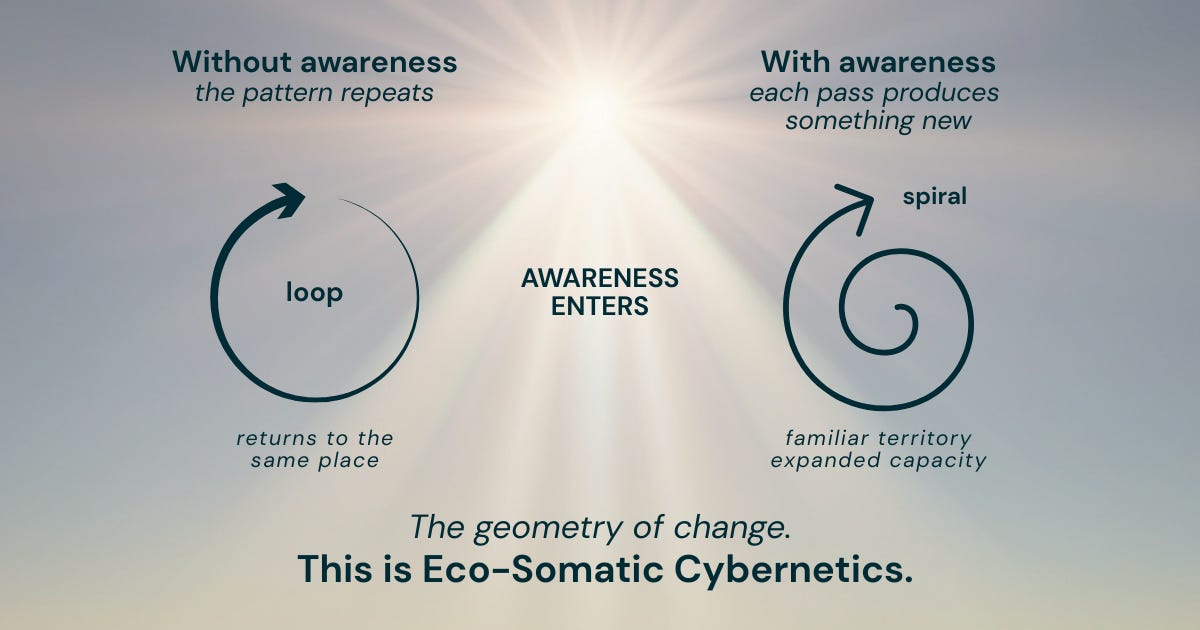
This is the insight at the heart of Eco-Somatic Cybernetics,16 the framework at the root of everything we teach at the Emunah Academy of Multidimensional Living. We are building from the lineage of Wiener and Maltz and many other teachers, and taking this work into the living body, into the nervous system, into the relational field, into the environment, into the Living World, and into the true potential that each of our lives, personally and collectively hold.
Eco-Somatic Cybernetics is the recognition that you are a living system embedded in living systems, shaped by feedback from your body, your relationships, your environment, and your own evolving awareness of all of it.
Through Eco-Somatic Cybernetics, we develop awareness, agency, and an ever-strengthening relationship with the wider systems we belong to. In doing so, we can shape change across the internal, interpersonal, institutional, and intergenerational dimensions of our lives.
Each pass through familiar territory, when met with awareness and presence, produces something the previous pass could not. Your bracing softens incrementally. Your self-image expands and evolves. The scope of what feels possible widens. Your nervous system learns that it has more range and more resilience than you ever previously assumed. And the life that was being unconsciously generated by invisible loops begins, gradually and measurably, to be consciously shaped by an aware human being who can finally see the nested systems you are living within.
Patterns that you believed were personality. Limits that you believed were reality.
Now that you are aware of them, you can begin to transform them through the wisdom of your own body and of the shared systems we all are nested within.
Your life is already shaped by feedback loops, the question now is what are you steering toward?
What futures will you create?
🖖✨🐌,
Seth!
Kramer, A. D. I., Guillory, J. E., & Hancock, J. T. (2014). Experimental evidence of massive-scale emotional contagion through social networks. PNAS, 111(24), 8788-8790 In this experiment with Facebook users, researchers tested whether emotional contagion occurs outside of in-person interaction by reducing the amount of emotional content in users' News Feeds, establishing that emotional states transfer through social networks without users' awareness. Note that this was ethically controversial as participants did not consent to participate.
Koestner, R., Zuroff, D. C., & Powers, T. A. (1991). Family origins of adolescent self-criticism and its continuity into adulthood. Journal of Abnormal Psychology, 100(2), 191–197. Mothers who were restrictive and rejecting at age 5 had children who were more self-critical at age 10. In women, the trait held into adulthood.
Schnall, S., Harber, K. D., Stefanucci, J. K., & Proffitt, D. R. (2008). Social support and the perception of geographical slant. Journal of Experimental Social Psychology, 44(5), 1246–1255. People estimated a hill as less steep when standing next to a friend, or even when imagining one. The closer the friendship, the gentler the hill.
A systematic review and meta-analysis of 604 studies with 1,014 effect sizes examined associations between perceived social support and five domains of human thriving including mental and physical health, risk-taking behaviors, educational functioning, and work performance.
Gordon, A. M., & Chen, S. (2014). The role of sleep in interpersonal conflict: Do sleepless nights mean worse fights? Social Psychological and Personality Science, 5(2), 168–175. Couples reported more conflict after poor sleep, less empathic accuracy, and a harder time resolving disagreements they could have resolved when rested.
A 2026 systematic umbrella review with meta-meta-analysis of 63 studies, 81 meta-analyses, 1,079 component studies, and 79,551 participants found that exercise reduces depression and anxiety symptoms, with aerobic exercise showing the largest effects.
Liston, C., McEwen, B. S., & Casey, B. J. (2009). Psychosocial stress reversibly disrupts prefrontal processing and attentional control. PNAS, 106(3), 912–917. Chronic stress measurably degrades the prefrontal cortex networks that support flexible thinking and creative problem-solving. They found that this is reversible after a month of reduced stress.
Kashdan, T. B., Barrios, V., Forsyth, J. P., & Steger, M. F. (2006). Experiential avoidance as a generalized psychological vulnerability. Behaviour Research and Therapy, 44(9), 1301–1320. Trying not to feel something keeps the feeling alive. This research found that avoidance is a primary mechanism by which anxiety persists and worsens.
Berman, M. G., Jonides, J., & Kaplan, S. (2008). The cognitive benefits of interacting with nature. Psychological Science, 19(12), 1207–1212. Walking in an urban environment depleted attention and working memory; walking in nature restored both. The effect held whether participants enjoyed the walk or not.
Hanna, T. (1988). Somatics: Reawakening the Mind’s Control of Movement, Flexibility, and Health. Hanna's term for this is sensory-motor amnesia: muscle patterns held so long the nervous system forgets they're optional.
Snyder, M., & Swann, W. B. (1978a). Subjects told their conversation partner was hostile behaved in ways that made the partner act hostile, confirming a belief that started out false.
The word cybernetics comes from the ancient Greek kybernetes, meaning steersman or helmsman. Norbert Wiener, a mathematician at MIT, coined the modern term in 1948 to describe the science of communication and control in both living organisms and machines.
Wiener was deeply influenced by the earliest research on the Autonomic Nervous System (ANS). Decades earlier, physiologist Walter Cannon had described the same living intelligence in his 1932 book The Wisdom of the Body, showing how the body continuously monitors its internal state and makes thousands of adjustments to maintain stability in a changing world. Cannon called that capacity homeostasis. Wiener called it cybernetics. Cybernetics would then go on to shape both the lineages that have brought us computation, the internet, and AI, as well as the legacy of the Whole Earth Catalogue, Gaia Theory, and Buckminster Fuller’s legacy.
Maxwell Maltz, Psycho-Cybernetics, 1960. Maltz observed that external change, including surgical transformation of appearance, rarely shifted a patient’s internal experience of themselves. He concluded that the self-image functions as the target a living system steers toward, and that changing the image is what changes the life. This book has been incredibly influential to the human potential movement, corporate mindset trainings, and new-age manifestation techniques.
Years ago I stumbled across Edward de Bono’s 1981 television episode on Norbert Wiener. It’s a little eccentric, very much a product of its era, and also brilliant. If this essay sparked your curiosity, I highly recommend watching it:
Rev. Ganga Devi Braun wrote about this in her own way back in December, here:

Eco-somatic cybernetics… looking forward to hearing more mate. Esther and I haven’t been using cybernetics ‘formally’ but the position re self organisation / self making system dynamics (and different inter-related / inter-dependent phenomena operating at different levels, which speaks to the relation between say conscious thought and nervous system patterning where conscious thought can change quickly yet the repatterning takes time, repetition, exposure etc. with the ‘right conditions’) deeply resonates. Very much aligned to the way we are bridging somatic therapy and philosophical counselling.
Be good to have another chat soon my friend.