


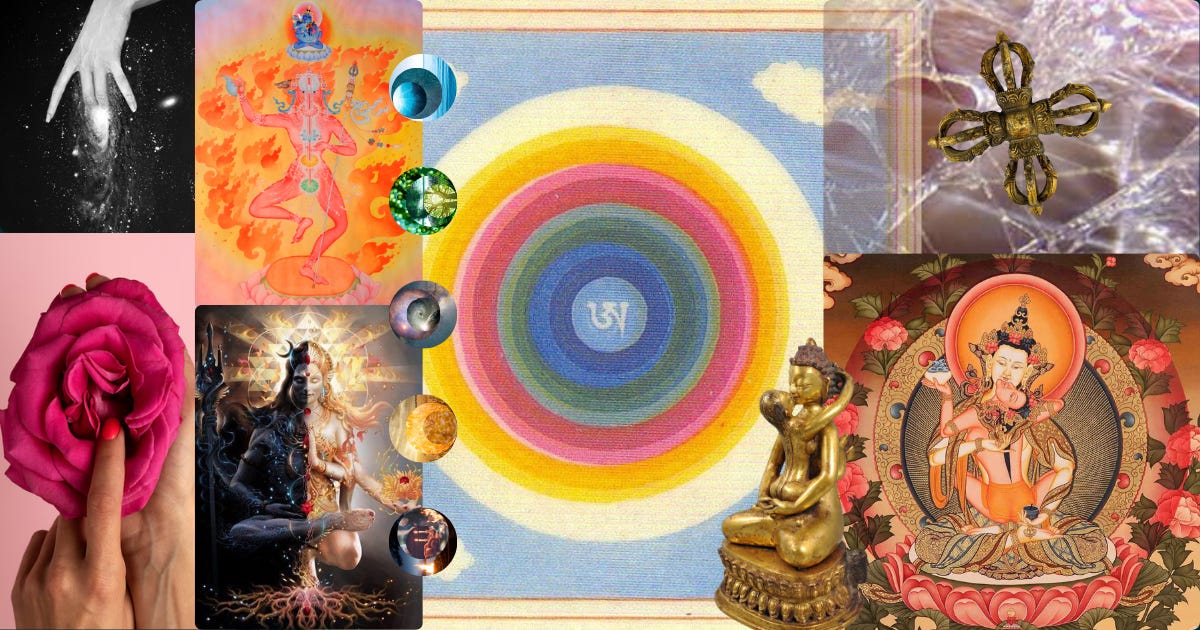
If you’ve spent any time around Tantra, you’ve likely felt this at some point. The word shows up everywhere. People speak about it with confidence. Sometimes with reverence, sometimes with excitement. And yet, when you try to understand what it actually is, things often feel less clear.
You may have read books that left you either underwhelmed or overwhelmed. Some are so academic they feel inaccessible. Others reduce the subject to vague promises and surface-level spirituality. You may have searched online, talked with practitioners, or compared perspectives, only to realize that the same word was being used to describe very different things.
That confusion is common. And it’s not a failure on your part.
Tantra, as it exists today, is rarely presented as a coherent whole. It has moved across centuries, cultures, and traditions, accumulating layers of interpretation along the way. What most people encounter now is not a single, unified teaching, but a cluster of meanings and practices, often decontextualized and diluted, all gathered together under one name. Expecting immediate clarity from that landscape would be unrealistic, even for thoughtful, well-intended people.
This essay is meant to offer orientation. To lay out the terrain clearly enough that the shape of Tantra can come back into view, without adding more noise or complexity. From there, we can talk honestly about what Tantra is, how it changed, and why so many people arrive at it looking for something that is sometimes branded as Tantra, but really should go by a different name.
What Tantra Actually Is (and Was)
At its root, Tantra is not a technique, a lifestyle, or a set of sexual practices. It is a lineage-based spiritual technology. A body of teachings designed to be transmitted, practiced, and lived over time, rather than sampled or applied for quick results. The depth of what this can offer to our lives is truly priceless (though that doesn’t mean it doesn’t deserve a clear and fair exchange).
The word tantra is often translated as “weaving.” Tantra refers to the weaving together of all dimensions of human life. Body and mind. Spirit and matter. Desire and devotion. Inner experience and outer action. Where many spiritual paths emphasize transcendence through renunciation or withdrawal, Tantra takes a different approach. It works with the fullness of lived experience rather than attempting to disconnect from it.
In many traditional tantric systems, nothing is excluded by default. Sensation, emotion, sexuality, ritual, breath, attention, sound, movement, and relationship are all considered legitimate gateways for awakening. The work is not about escaping the world, nor about indulging in it, but about learning how to meet life as it is with increasing clarity, presence, and responsibility.
Because of this, Tantra was never meant to be casual. Classical tantric practice unfolded within clear containers that included ethical commitments, devotional orientation, and disciplined repetition. Teachings are transmitted within lineages for a reason. At their core, I don’t believe this is to create hierarchy, but to preserve coherence. The practices are powerful, subtle, and often destabilizing if approached without guidance or preparation.
It is also important to understand what Tantra was, and is, oriented toward. Its aim is liberation. Liberation here does not mean escape from the body or the world. It refers to freedom from compulsive patterns of grasping, aversion, and unconscious repetition of cycles that cause harm. Freedom from being run by forces we do not understand or cannot feel. In that sense, Tantra is concerned with power, but always in relationship to wisdom, compassion, and responsibility.
This is why ritual plays such a central role. Ritual in Tantra is not symbolic theater. It is a way of shaping attention, stabilizing the nervous system, and aligning inner experience with larger intelligences, whether those are understood psychologically, cosmologically, or spiritually. Devotion is not about submission to authority, it is a practice of orienting desire toward something larger than personal gratification. Discipline is the structure that allows subtle changes to accumulate over time.
Sexuality is present and taught within some tantric systems, but it was never isolated from this larger framework.
Sexual energy is understood as one expression of life force among many, potent precisely because it is tied to survival, creation, attachment, and identity all at once.
Working with it requires maturity, containment, and a long apprenticeship in attention.
In many lineages, sexual practices are introduced late, if at all, and only after years of preparatory work.
Within Buddhist tantric traditions, these same principles are taken even further. Practices are explicitly oriented toward awakening for the benefit of all beings, not personal fulfillment alone. Visualization, mantra, breath, and subtle body practices are used to transform perception itself, gradually dissolving the sense of separation between self and world. Sexuality, when present, is framed within vows, ethical commitments, and a clear motivation toward liberation.
All of this is to say that Tantra, as it originally functioned, was a comprehensive path. It was slow by design. Subtle by necessity. Demanding in ways that are not always visible from the outside. When encountered as a whole, it offers a deeply coherent way of working with desire, embodiment, and consciousness. When encountered in fragments, it can easily lose its shape.
How the Word Drifted
Roughly fifteen hundred to two thousand years ago, what we now call Tantra began to take form in India as a wide body of texts and practices. These teachings emerged primarily within Hindu Shaiva and Shakta traditions and later found expression within Buddhist lineages as well. They addressed ritual, ethics, devotion, meditation, breath, subtle anatomy, and liberation as a unified path. Sexuality was present, but it was never isolated. It lived inside a much larger spiritual architecture.
The Tantras were not written as introductory guides. They assumed long preparation, oral transmission, and guidance within a lineage.
Between roughly seven hundred and a thousand years ago, tantric Buddhism moved into Tibet. There, the teachings were translated, preserved, and systematized with extraordinary care. Tibetan lineages integrated these practices into a disciplined path that emphasized ethical vows, preparatory work, devotion, and liberation-oriented motivation. As Tantra entered the Tibetan cultural landscape, it also encountered Bön, the region’s indigenous spiritual tradition. Certain ritual forms, symbols, and cosmological language were adapted, while the core tantric architecture remained intact. Sexual practices, when included at all, were focused, advanced, and sacredly contained.
From the 1960s onward, Tantra entered the modern Western world through a very specific cultural wave. Eastern spiritual traditions were being imported rapidly without the structures that once held them. At the same time, sexuality was emerging from decades of repression, entangled with countercultural movements and a longing for freedom that had few stable outlets.
Tantra did not arrive as a complete spiritual path. It arrived through alteration, experimentation, and desire because sex sells.
So, rather than being received as an integrated system, Tantra was encountered through fragments.
People met it through workshops, books, practices, and experiences that could be entered quickly and felt immediately. Over time, the deeper scaffolding that once shaped those practices became consistently erased. What remained was compelling, yes, and life changing for many, but no longer held within the same architecture.
This is why most of what is called Tantra in the West today should be called “Neo-Tantra.”
Neo-Tantra is not transmitted through authentic lineage. It emerged through translation, psychology, counterculture, sexual liberation, and selective borrowing. Much of it may have been well-intended. It aimed to heal sexual shame, restore pleasure, and bring consciousness into intimacy.
And for many people, it has done some of that.
But something important is missing.
When practices designed to work slowly are lifted out of their original containers, their effects can actually accelerate. Sexual energy amplifies quickly. Without sufficient grounding and integration, this acceleration can create serious harm. What is meant to unfold gradually can become overwhelming, confusing, or destabilizing.
This might feel like a strange critique in a culture that always teaches us that faster is always better, but when the working definition of trauma is “anything too much, too fast, or too soon for the nervous system to process,” I hope you can begin to see the danger here.
In Neo-Tantra trainings, spontaneous movement, emotional release, shaking, vocalization, energetic surges, and cathartic expression are frequently taken as signs of deep, powerful awakening. People get jealous if they don’t have these experiences. Often people will perform them for others in order to not feel left out or left behind.
Don’t get me wrong, for many people these experiences can be meaningful. Life changing, even.
But from a physiological perspective, these experiences can also reflect a nervous system moving faster than its capacity to integrate. When charge rises more quickly than the body can stabilize, expression becomes explosive rather than coherent. What looks like liberation can, at times, be a system discharging excess activation. Without sufficient containment and integration, this can feel transformational in the moment while quietly reinforcing the very patterns people are trying to heal.
These intense physiological responses should be treated as stop signs, not goalposts.
There is a widely circulated photo of Elon Musk’s bedside table, where a Tibetan dorje (vajra) rests beside two handguns (and several cans of Diet Coke). This was immediately concerning to many of us who study and practice within this tradition.

In Vajrayana Buddhism, the dorje is not a symbol of dominance or force. It represents indestructible clarity and awakened power, always held in service of compassion. It is inseparable from bodhicitta - the intention that one’s strength, insight, and realization exist for the benefit of all beings, not personal elevation.
Classical Tantra is explicit about this:
power without bodhicitta is incomplete. And often, dangerous.
Because tantric technologies amplify capacity. They increase intensity. They expand influence. Without ethical orientation and devotional grounding, that amplification does not liberate. It magnifies whatever motivations already exist.
This is why traditional Tantra placed such extraordinary emphasis on vows, discipline, and ethical development long before introducing advanced energetic practices. Not to restrain power, but to direct it toward the benefit of all. Can you imagine if Elon Musk actually cultivated his power in this way?
In classical Tantra, capacity was built before intensity.
In Neo-Tantra, intensity often arrives before capacity.That reversal carries consequences.
Today, the word Tantra is being asked to hold a wide range of meanings at once. Ancient Hindu and Buddhist traditions. Tibetan Vajrayana lineages. Modern sexual healing and intimacy work. Somatic practices focused on the nervous system. Personal growth paths integrating some sexuality and shaped by contemporary psychology.
These are not the same paths. They do not share the same aims. But they are spoken about as if they do.
And that makes one thing very clear to me: many people who think they want Tantra are actually seeking something else.
What People Are Actually Seeking
When people come to me saying they want Tantra, they are looking for a solution to a problem.
They come because something isn’t working the way it used to. Or never quite did. Because intimacy feels lacking. Because they feel disconnected from their bodies, or overly driven by them. Because sex has become either effortful, compulsive, numbing, confusing, or non-existent. Because they long for sexual connection that feels truly meaningful.
What they say they want varies. Better sex. Deeper intimacy. More pleasure. To bridge their spiritual and erotic lives. But beneath all of the different strategies, there is a core need that everyone shares.
The need for stability in their nervous systems.
For the ability to stay present as sensation intensifies.
For a greater range for pleasure without bracing or losing themselves.
For healing around sexual patterning that may have formed long before words were available.
For less effort, less performance, and more flow.
None of this is fringe. None of it is indulgent.
These are genuine needs in a culture that has done very little to teach us how to live comfortably inside our own arousal.
Most of us were never shown how to relate to sexual energy without either suppressing it or being overtaken by it.
What matters here is precision. These desires are not requests for a lineage, a worldview, or a religious path. They are requests for embodied skill. For training. For a way to work with sensation, breath, attention, and touch that actually helps the body reorganize itself.
When those needs are named clearly, the search becomes less abstract and the body no longer has to borrow spiritual language to explain a physiological request. This distinction matters because it’s the place where my own work took shape.
My relationship with Tantra spans decades, beginning with the Neo-Tantra that was originally accessible to me, and deepening into lineage-based, formal study. Alongside that path, I completed a master’s degree in physiology. I learned to think in terms of systems, thresholds, adaptation, and tolerance. I learned how bodies change under stress. How patterns form. How lived experience becomes woven into tissue, breath, and behavior.
Over time, I began to notice something that language alone couldn’t explain.
My clients weren’t changing necessarily because of the Tantric frameworks and practices I was sharing with them per se. They were changing when their bodies truly integrated a new pattern. When breath slowed where it usually sped up. When sensation could rise without triggering contraction. When attention stayed present instead of fragmenting. When sexual energy began behaving like a current the body could hold - and use to metabolize long-held, often unconscious patterns stored in tissue, breath, and nervous system memory.
I also noticed that many of the people drawn to Tantra were quietly overwhelmed by the whole system I was trained to teach. The ritual language didn’t land. The cosmology felt distant, and, frankly, disconnected from their own worldview. The lineage structures weren’t what they were asking for. What they wanted was practical. Secular. Direct. A way to train their bodies to respond differently under real conditions.
I knew I needed to adapt to serve my clients better, but I very clearly did not want to reproduce the same harmful patterns I see in Neo-Tantra.
Slowly, organically, a synthesis emerged.
It wasn’t an alternative to Tantra. And it wasn’t an attempt to modernize it. It was a response to what was actually happening in people’s bodies. A form of somatic, sexological training that worked directly with nervous system tolerance, pleasure range, contemporary neuroscience, and presence under arousal. No spiritual bypass. No borrowed authority. Just clear inputs, repeated over time, that allowed the body to reorganize itself.
Most people who came to me seeking Tantra didn’t need more philosophy. They needed skill. They needed containment. They needed to feel safe enough in their bodies to stay present. Once that need is met, something important becomes clear.
Tantra and somatic sexological work are neither the same thing, nor are they competing paths. They serve different functions. Each becomes distorted when it is asked to do the work of the other.
Classical Tantra is a spiritual path. It is devotional, disciplined, and oriented toward collective liberation. It unfolds over time. It asks for patience, humility, and a willingness to be shaped by practice, ritual, and lineage. It is not designed to move quickly, and it is not meant to center the personal self or sex decontextualized from your entire life system. Its horizon is far larger.
Somatic sexological work, as I teach it, is a physiological and relational training. It works directly with your nervous system, fascia, breath, and erotic charge. Its purpose is not transcendence, but grounded wholeness. Integration. Deep healing. Embodiment. Capacity.
And it, too, requires patience. It asks for repetition, consistency, and a devotion to small, precise changes over time. The devotion here is not to cosmology or ritual, but to listening. To learning how your body actually responds. To staying with sensation rather than overriding it. To building trust inside your own physiology.
It’s confusing when Tantric Practice and Somatic Sexological work are blurred, even though the venn diagram between them includes some real, fascinating overlaps.
It’s confusing when a spiritual path is expected to resolve nervous system trauma.
When somatic training is expected to provide existential meaning.
When liberation and stabilization are treated as interchangeable.
They can be connected, but they are not the same thing.
And when they are placed in right relationship, something relaxes.
Tantra is a profound spiritual path for those who feel genuinely called to it.
Somatic sexological work is a grounded, secular foundation for those who are ready to inhabit their bodies with more safety and pleasure.
One does not replace the other. Each becomes clearer when it is allowed to be what it actually is.
This is why we made the EDGE, so that you can become your own somatic sexual healer. the EDGE is a self-paced course to build the physiological stability, pleasure expansion, and nervous system coherence that make deeper intimacy, emotional healing, and spiritual integration possible. And for those who later feel drawn toward lineage-based Tantra, the EDGE serves as a perfect prerequisite, creating a foundation of a more stabilized, attuned, present, and receptive nervous system from which to step into the power of the elemental Tantric practices that I am honored to be able to teach.
Whether your path leads toward somatic practice, deeper connection, spiritual inquiry, or all of it woven together, what matters most is that your body feels safe enough to stay present for what’s unfolding.
If this orientation resonates, you’re welcome inside the EMUNAH ΛCΛDEMY of Multidimensional Living, an evolving space of practice, remembering, and embodied change, with experimental community gatherings emerging around rich topics.
I look forward to meeting you there!
🖖✨🐌,
Thank you, I always find that little connections fire in my brain when I read your pieces. Lots of nuance, lots of nuggets of wisdom!
Highly abused teachings on ancient India is Tantra. Unfortunately people also fall easily for it as everyone is looking for quick and short route to experience something and marketplace is ready to cater that. Thank you for writing in this.