


A Note Before We Begin
A lot of the techniques, knowledge, and tools I use in my practice come from systems I didn’t initially seek out to use professionally, but just pursued in my endless personal curiosity to understand everything I possibly can in this world.
In that pursuit, I’ve ended up with a lot of extensive training in systems that I integrate into my practice, including what I share in this essay.
Before I ever stepped into the worlds of energy work, somatics, or esoteric anatomy systems, I was trained in the rigor of both journalism and scientific research.
That’s the foundation I build on.
I try to be a true skeptic—discerning, not dismissive. Not someone who doubts everything, but who asks questions and stays curious.
I test what I learn not just against research, but against direct experience, multiple worldviews, and the intelligence of the body itself.
I try to not take the western scientific model as a dogmatic doctrine, but as one insightful worldview of many.
And when I study deeply within other traditions like the Tibetan energetic lineage I’ve trained in over the past five years, I don’t just absorb. I integrate. I cross-reference. I look for what’s coherent, living, and real.
This essay is part of that integration.
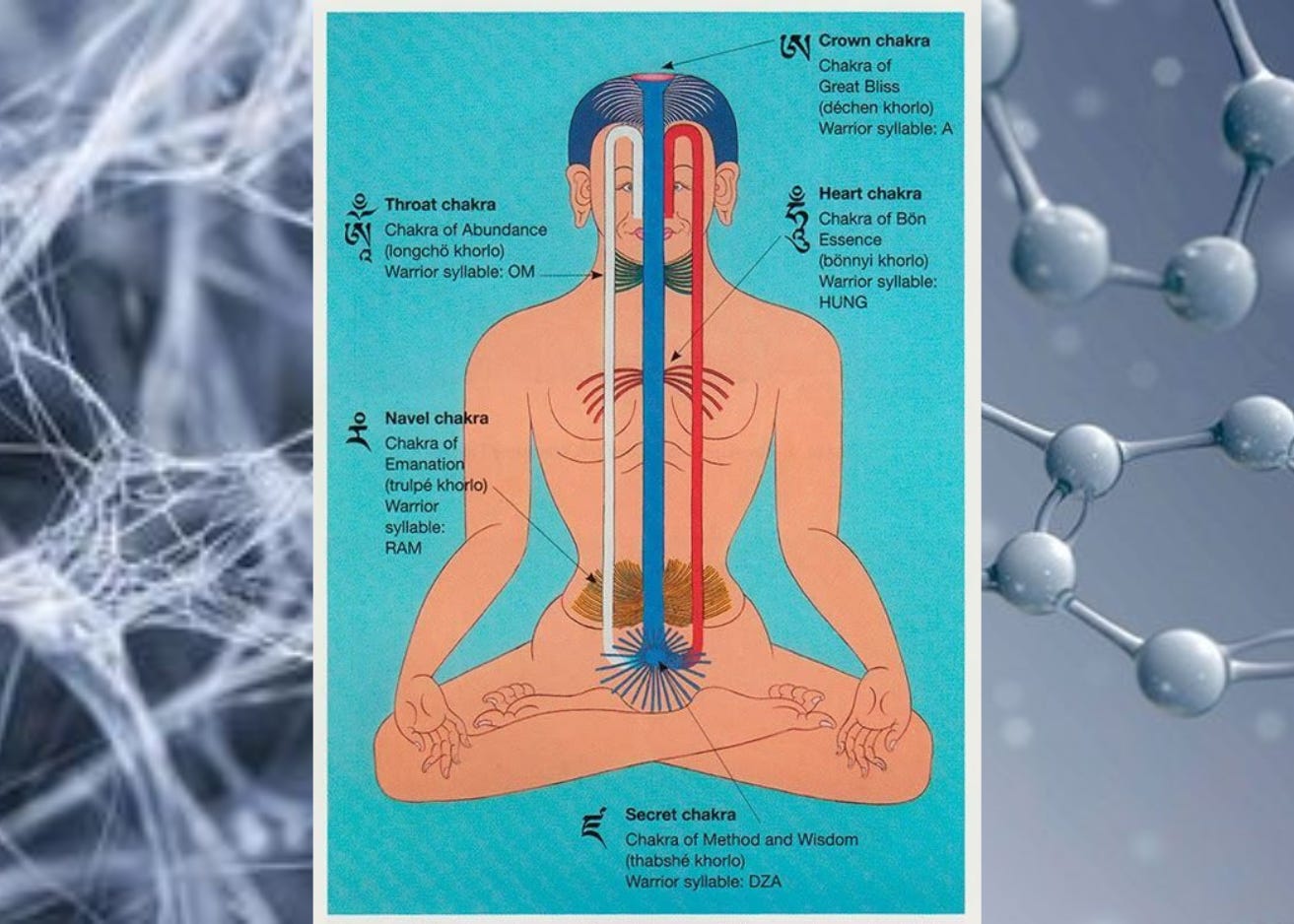
I’ve spent decades investigating the question that most people skip over in energy work:
What’s actually happening in the body?
Those breathless moments of deep stirring—the emotional floods, the tingles that move across your skin, like messages arriving from somewhere just beyond language.
I’ve felt all of this, in many different settings, with different catalysts, modalities, and practitioners.
And the deeper I went, the more I kept circling back to that question:
What’s really going on here—not in theory, but deep in the tissues?
The more I’ve studied, the clearer it’s become that most people working with energy are trying to use maps (and interpretations of those maps) that present a limited view of the vast and beautiful multidimensional reality of our bodies.
I’m talking about the seven-chakra model.
You know the one: stacked rainbow colors, tidy emotional themes (red for safety, blue for truth), often found on t-shirts, tapestries, metaphysical shop windows, and yoga studio walls.
It’s not wrong. It’s just that the way we interpret and understand it in the west is often both rigidly dogmatic and incomplete.
It’s stripped of context, of anatomy, of nuance, and often split from the body itself.
The truth is that chakras aren’t floating wheels of light. They’re oscillating, fascia-embedded, neuro-hormonal hubs.
Not mystical metaphors: functional interfaces.
And energy doesn’t move just because you visualize it.
It moves because your fascia is fluid, your nervous system is attuned, and your subtle body has room to breathe.
Visualization can genuinely help with that, but understanding what’s actually going on empowers each of us more wholly.
This is where ancient wisdom and modern science meet:
Fascia as the conductor of subtle energy
Nadis as fractal pathways embedded in connective tissue
Chakras as dynamic endocrine-somatic centers
Breath, emotion, movement as the actual forces that open the field
Because what you too may have felt in glimpses during breathwork, in stillness, mid-movement or in the quiet after release is real.
But without the full map, it’s hard to trust it, harder still to integrate and sustain.
Today I’m taking a step to help restore the full picture.
One that includes the fascia, the glands, the nerves, the nadis, the trauma imprints, and the cosmic intelligence of your own body.
This is not about fixing the body to access energy.
It’s about realizing that your body is the energy: organized, intelligent, alive.
The Chakra Map Was Never Meant to Be Flat
How Energy Moves Through Fascia, Nadis, and the Living Architecture of Your Body
The seven-chakra system that’s now ubiquitous in the West has roots in Indian yogic texts that are a few hundred years old, but was popularized through early 20th-century Theosophy, especially the writings of Charles Leadbeater, and presented as a singular truth.
The Theosophical movement helped spark interest in Eastern traditions for many Western spiritual seekers. In some cases it was explicitly seeking to protect these systems from the harms of colonialism, but in the process it also reframed complex lineages through a Western esoteric lens, blending Christian mysticism, occultism, and selective interpretations of Hindu and Buddhist systems.
This could be fairly characterized as a second order expression of colonialism. Not the overt seizure of land or labor, but the subtler extraction of cultural knowledge removed from context, lineage, and reciprocity.
Since then, the chakra model was further distilled through Western adaptations of yoga and New Age spirituality.
And in that process, something essential was lost.
Deep traditions were lifted from their cultural, philosophical, and somatic roots, and repackaged in ways that were easier to consume—but also more fragmented.
For many people, that simplification has offered a gateway. Here was an energetic model of anatomy that affirmed something so many of us intuitively feel: that the body carries subtle, powerful dimensions that can be worked with for healing, clarity, and transformation of deeply engrained patterns.
But let’s be honest—most energy work today is practiced and shared without a clear understanding of where it comes from.
And rarely, if ever, is there inquiry into lineage.
In the West, it might even feel rude to ask:
Where does this come from?
Who taught you this way?
But in the cultures these models originated from, those questions are fundamental.
If someone can’t answer them with clarity, you’d walk the other way.
There are lineages of knowledge and initiation that have been passed down in unbroken streams for hundreds, sometimes thousands, of years. Innovations absolutely happen within these lineages.
But the lineages themselves are intact.
They have names.
They have histories.
They have oral transmissions, initiation protocols, and guidelines for maintaining integrity.
Practitioners should be able to name them with clarity and respect.
We live in a moment where that’s rare. But I (and my teachers) don’t believe the answer is for people outside these cultures to reject or abandon the wisdom that moves them.
But it does mean honoring the traditions these systems came from.
It means studying deeply. Giving credit. Listening more than assuming.
Because what’s often been decontextualized still is being transmitted with integrity, clarity, and deep praxis.
In the Shangpa Kagyu and Bön lineage in which I’ve trained, we work with five primary chakras.
Not because there are only five—but because these are the deepest convergence points.
They’re where the most nadis intersect, where elemental forces concentrate, and where the body’s hormonal intelligence expresses through the endocrine glands.
In some yogic and tantric systems, it’s said there are 114 chakras throughout the body, though even that number is symbolic more than absolute.
The truth is, your body contains countless energetic intersections—some subtle, some powerful, all responsive to breath, emotion, and awareness.
Different traditions map different hubs.
The five I work with are simply the largest energy centers, where the greatest number of nadis converge and transformation becomes most accessible.
Chakras as Energetic Hubs, Not Floating Symbols
So how does this actually work in the body?
The word chakra literally means “wheel.” But these aren’t spinning disks of rainbow light hovering in space.
They’re real, responsive hubs—places where energy pathways cross and concentrate.
So think of chakras not as fixed locations, but as places where energy pathways intersect like spokes in a bicycle wheel.
The energy that moves through them flows along the nadis—subtle channels embedded in your fascia—like signals traveling through a mycelial network.
And I don’t just mean that poetically. This kind of branching, intelligent architecture shows up all throughout nature.
Neurons branch like trees. Mycelium connects the forest in intricate webs. River systems braid and bifurcate. Lightning forks. All of it is energy transfer.
Your body mirrors these same fractal patterns because it is made of them.
Nadis. Nerves. Myofascial spirals. They all echo this deeper intelligence:
It’s not linear. It’s intelligent. Fractal. Alive. Neuro-hormonal.
That last one might sound technical, but here’s what it means:
These systems don’t operate in isolation. Every energetic shift involves your nerves firing, hormones signaling, fascia responding. Your energy body is also your neuro-hormonal body.
The more intersections there are—of nerves, fascia, and subtle energy—the more sensation is possible in that area.
The more influence that center has on your emotional and physiological state.
And the more potential it holds for deep transformation.
That’s what makes these five so potent.
And no, this doesn’t mean the seven-chakra system (or the twelve, or the 114, or others) are wrong.
They’re just different lenses—different ways of mapping an infinitely complex, intelligent field.
If anything, the number of chakras is less important than how you engage them.
When you get full-body chills in a moment of deep revelation, clarity, or healing, that energy isn’t flowing through a fixed set of abstract symbols. It’s flowing through your fascia.
Fascia & Nadis: The Fractal Fabric of Energy Flow
The nadis (subtle energy channels woven through the fascia) form a vast, intelligent network.
Ancient texts speak of 72,000, but that number is symbolic. What matters is that these channels are everywhere, threading through the body like consciousness in motion.
Some lineages say there’s a nadi for every pore. Others describe them as the rivers beneath the skin, pulsing with breath, emotion, and subtle awareness.
What modern science is beginning to catch up to is this:
Those “invisible” pathways are embedded in your fascia—the connective tissue that wraps every organ, muscle, nerve, and vessel.¹
Fascia isn’t just physical. It’s electrical. It conducts charge, stores emotion, and adapts to tension or trauma like a living feedback system.²
When fascia is hydrated and responsive, energy flows.
When fascia is dehydrated, frozen, or braced, energy gets stuck.
Which means your emotional states, movement patterns, and breath cycles aren’t just physical experiences. They’re instructions to your subtle body. They’re shaping the flow of energy, one tension pattern at a time. That energy flow then shapes your tissues again, in a recursive loop.
This is why so many people feel blocked even when they’re doing the “right” energy practices. Visualization doesn’t always override the body’s deeper signals.
Your body isn’t resisting your healing, it’s protecting you. Fascia remembers what your mind may have forgotten. And now, you can start listening.
Fascia & the Hormonal Axis
Most people think of hormones as separate from energy: one belongs to biology, the other to spirit, but this is a false dichotomy. Hormones may be biochemical, but they carry power. They drive emotion, behavior, attention, and transformation. And fascia is the interface between those hormonal signals and your lived experience.
When you start to understand this connection, “energy work” stops being abstract.
You can experience it for the physiological phenomena that it always has been.
The HPA Axis: The Hormonal Command Center
At the center of it all is the HPA axis—the connection between your hypothalamus, pituitary gland, and adrenals. This axis regulates your stress response, sleep cycles, libido, metabolism, immune system, and mood.
In trauma states, it can stay stuck in overdrive or collapse entirely. And the body often reflects this dysregulation in the fascia: tightness in the jaw, gut, pelvic floor, diaphragm, neck.
Which means that chronic tension in fascia = chronic miscommunication in the hormonal system.
Each Chakra Is an Endocrine-Somatic Zone
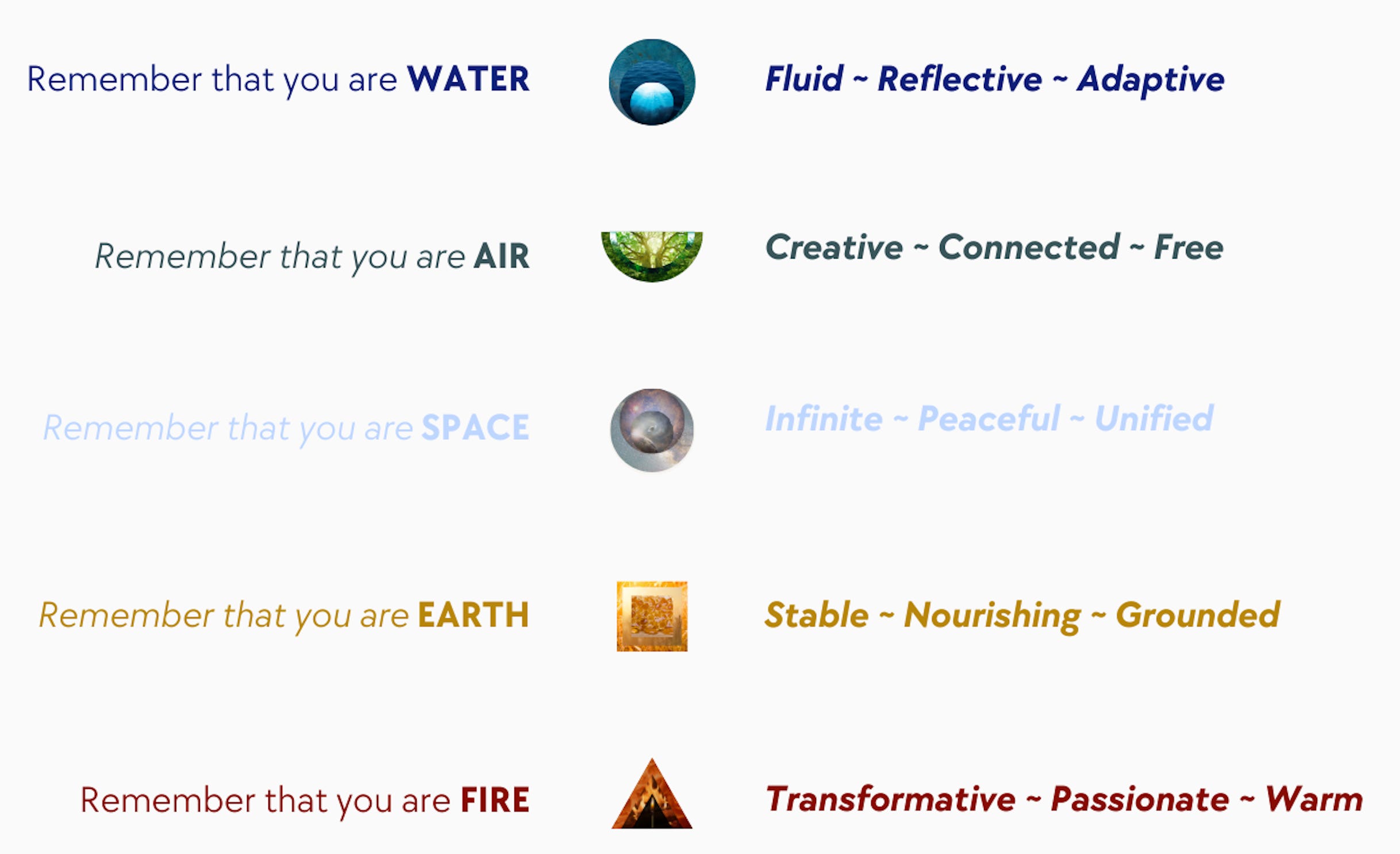
In the system I work with, each of the five primary chakras corresponds to a core endocrine gland⁴, a layer of fascia, and a somatic-emotional intelligence:
Head Chakra (Water) → Pineal
Vision, perception, circadian rhythm, emotional clarityThroat Chakra (Air) → Thyroid
Expression, metabolic clarity, energy exchange, breath regulationHeart Chakra (Space) → Thymus
Connection, compassion, openness, immune balanceNavel Chakra (Earth) → Adrenals
Stamina, grounding, boundary setting, survival stressSex Chakra (Fire) → Gonads
Creativity, sexuality, discernment, primal energy, regenerative force
These aren’t just metaphysical associations.
They’re deeply embodied, and they show up in our physiology, posture, emotions, and movement.
When fascia in these zones is soft, hydrated, and attuned, energy can move.
Hormones can regulate. The system begins to oscillate in harmony.
Chakras Aren’t Stuck or Broken, They’re Adaptive
The idea of “blocked” chakras is common but often misunderstood. What feels like a blockage is usually a protective adaptation. Your system managing overload, trauma, or stored survival responses.
These centers are responsive, not static. They shift with:
Breath
Movement
Emotional regulation
Nervous system state
Relationship and environment
A balanced chakra isn’t always “wide open”. It’s coherent.
It’s able to respond, adjust, and recover.
That’s what I mean by dynamic: not locked in place, but alive, rhythmic, and intelligent.
Fascia, Lymph & the Missing Flow
Here’s the layer almost no one is talking about: Fascia doesn’t just wrap your muscles, it wraps your lymphatic system.³ And the lymphatic system is the detox river of the body. It clears cellular waste, supporting immunity, and regulating inflammation.
I want to be really clear here: You don’t need a juice cleanse or a special supplement to “detox.” Your body already knows how to detox—through the liver, kidneys, skin, breath, and especially the lymphatic system.
But here’s the part often missed in mainstream science and wellness marketing: Detoxification isn’t just about what you ingest. It’s about how well your tissues can move, drain, and reset.
That’s where fascia comes in.
When fascia is braced, compressed, or dehydrated, it can restrict lymph flow—leading to stagnation, inflammation, and that foggy, weighed-down feeling.
Support the fascia, and you support the body’s innate ability to clear waste and restore clarity.
Lymph flow depends on movement, breath, and hydration—all of which are influenced by fascia. When fascia is stiff or braced, lymph can’t circulate properly. That’s why people often feel foggy, inflamed, or heavy when they’re stressed or stagnant.
When fascia releases, lymph moves.
You feel clearer. Lighter. More awake.
That clarity you feel after movement or tears?
That’s not just energy as an abstraction, it’s biological.
It’s: fascia softening → lymph draining → hormones recalibrating → nervous system shifting → energy reorganizing.
That same clarity can come after sex, especially in the refractory phase post-orgasm.
Because orgasm is a massive energetic event.
It’s electromagnetic, hormonal, emotional release.
It clears. It reboots. It flows.
It can also come after breathless laughter, wild dancing, or deep sobbing—
any moment where the body finally says:
“I’m safe enough to let go.”
What someone might call a “chakra opening” may also be the body:
Clearing inflammation
Completing a stress cycle
Re-entering a coherent flow state
This Is the Real Energy Body
When people talk about energy and the energy body, it usually feels abstract.
Invisible. Esoteric. Floating above the body.
But real energy is biochemical.
It’s hormonal. Electrical. Emotional.
It flows through lymph. It surges with breath. It pulses through fascia.
So when we say “energy is stuck,” we might also mean:
Lymph isn’t moving.
Hormones are misfiring.
The nervous system is locked.
The fascia is holding old trauma like armor.
And when energy flows again? The body softens. Detox happens naturally. Immunity resets. Perception clears. Consciousness expands.
Fascia is the bridge.
Glands are the signalers.
Lymph is the cleanser.
Chakras are the intelligent nodes that organize it all.
This isn’t about transcending the body.
This is the body—awakening itself.
Not spiritual bypass.
Biochemical coherence.
And it changes everything.
The EDGE: Where Energy Becomes Embodiment
If what you’ve just read resonates, if you’ve ever felt that “lightning in the fascia” but haven’t had a framework for what’s actually happening, The EDGE was designed for you.
It’s a six-phase process that grounds subtle energy in direct, embodied experience by way of working with sexual energy, which is life force energy.
Through meditative masturbation, breath, and awareness, you’ll learn to circulate sexual energy through the same fascial, hormonal, and lymphatic pathways described here—bringing theory into felt reality.
Pleasure isn’t separate from physiology; it’s the signal of coherence returning to the system. When the fascia softens and the current of sexual energy flows freely, we experience energy healing from the inside out.
If you’re ready to explore how this understanding of fascia, glands, and subtle energy becomes a living practice, to feel the architecture of your energy body from the inside out, I invite you to join me inside The EDGE.
🖖✨🐌,
Seth!
PS: There’s more I want to explore on this topic. A lot more. The deeper I go into this work, the more I notice patterns—connections across physiology, energy, movement, and memory—that keep revealing themselves. Rather than try to say everything at once, I’ve broken this into two parts (to be honest, there will probably be more parts). The next piece moves into the elemental architecture of the body, what is known as ‘Kundalini’, the nature of energy as oscillation, and how these systems might be part of something much vaster than we’re taught to perceive.
I want to name that this perspective reflects my current understanding—shaped by my training, experience, and conditioning. There are people—maybe even you—who hold more depth, history, or nuance than I do in certain areas.
This is just the view from where I stand today.
I look forward to learning more, evolving this framework, and continuing to listen for what lives beneath the surface. (And yes—stay tuned for my essay on underground pre-civilizations, inter-terrestrial beings, and those orb sightings 🛸)
References
Pollack, G. H. (2013). The Fourth Phase of Water: A Role in Fascia?
Benias, P. C., et al. (2018). Structure and Distribution of an Unrecognized Interstitium in Human Tissues. Scientific Reports.
de Solórzano, S. L. (2021). Everything Moves: How Biotensegrity Informs Human Movement.
Wilke, J., & Krause, F. (2022). Innervation of Human Superficial Fascia.
Bordoni, B., & Varacallo, M. (2024). Anatomy, Fascia Layers. National Library of Medicine. Read here
This comprehensive review presents fascia as a multifunctional system involved in sensory perception, hormonal regulation, immune response, and structural integrity, supporting its role as a central conductor in the body’s energetic and physiological systems.
so grateful i happened to come across your account. thanks for this brilliant, coherent, insightful exposition on the very real biology (nerves, electricity, fluids, etc) of energy. i am a bodyworker (LMT) and i look forward to more of your writing!
Great article. I'm very interested to see what you will write about Kundalini. I had a spontaneous Kundalini experience a few years ago. I'm also autistic and have had bouts of autistic catatonia and neuroinflammation. So my experience of my nervous system and fascia is always interesting to say the least. I've been pondering if the Kundalini experience is a nervous system experience and the bliss we experience in that state is a neurological process.
Not to sound too material. I'm a nondualist. It's more that I think the body exists as an animation, an expression, of consciousness. The body reflects the nature of nature, just like everything else does.