

These Cuckolds Need a Daddy, Let’s Give Them One
Why the Most Dangerous Men in the World Never Finished Growing Up, and the Whole World Pays for It

Most people don’t know what the word cuckold means. And the ones who think they do know it from the adult lifestyle, referring to a consensual sexual fetish where a husband, a cuck, watches or knows about his wife having sex with another man. The word cuck has become shorthand for the ultimate masculine humiliation, a man stripped of position and agency.
The word itself comes from the cuckoo bird. The cuckoo doesn’t build its own nest. It finds another bird’s nest, deposits its egg, and leaves. The host bird, none the wiser, raises the cuckoo chick as its own, exhausting itself feeding a demand it didn’t create and can never satisfy. The cuckoo chick, for its part, often pushes the host’s own eggs out of the nest entirely.
This is where the real meaning lives, and it’s why I’m using the word here.
Not the sexual humiliation angle (though we’ll get there) but this: a creature living in the wrong life and consuming everything around it in the process, unconcerned of the collateral damage.
What we’re looking at here is not fringe behavior. It’s a pattern of men who are so disconnected from their authentic selves, from any models of mature, integrated masculinity, that they construct distorted identities to compensate. Those identities don’t just affect them. They shape their relationships, they shape the environments they lead, and in many cases, they shape the world we are currently living in. Take a look around. How’s that working out?
I want to be clear that I am not here to kink shame, but rather to discuss a dynamic living in the shadows of masculinity that needs to be named and addressed.
When someone is conscious of their desire for a cuckold dynamic and seeks it out consciously and consensually, with their partner’s pleasure centered, I have tremendous respect for them.
I have known and worked with many couples working with this dynamic, and I want to be clear that I feel that is the healthiest expression of something that otherwise comes out in the shadows.
It’s those shadows that I will be examining here today, in four interconnected archetypes of deeply distorted masculinity shaping our world’s power structures right now. And I will be sharing why stepping into the healthiest expression of the Daddy archetype is something all of us can do to counterbalance this distortion.
When Boys Never Become Men, This Is What Happens
Every single one of us holds every past version of ourselves in us. The newborn, the toddler, the child, the pre-adolescent, the teenager. They are all there, nested within us. When we are mature and integrated, we can access and care for those versions of us. I always tell my clients, “it’s never too late to have a happy childhood”. And I have seen again and again that as you do the work of maturation, you are more and more in touch with those versions of yourself, consciously.
The danger is on the other side of the spectrum, when those versions of you are running the show and you don’t even realize it. This is what depth psychologist Bill Plotkin calls “Patho-Adolescence” and it is not just present in individuals, it is the arrested development state of our entire dominant culture, specifically led by men who never had the guidance to properly grow up.
You don’t have to look very hard to see it. This is not about a fringe group or a specific lifestyle. This is about the consequences of a culture that has no consistent pathways for the development of mature masculinity.
Most “men” have never been guided through the transition that would allow them to actually become adults in a healthy, integrated way. They grow into adult bodies, accumulate skills, build identities, but something essential never fully forms. The stage that requires a man to face himself, to be shaped by reality, to take responsibility for his impact and his inner world gets bypassed, rushed, or avoided altogether.
You see it in men who swing toward extremes. One man builds his identity around dominance, control, and certainty, gripping harder the moment anything threatens his position. Another rejects strength entirely, collapsing into passivity, avoidance, or endless self-doubt. Others cycle between the two, trying on versions of power, sensitivity, spirituality, or success, none of which actually hold as authentic when pressure is applied.
The little boys living inside of grown men are longing for something to model themselves after. That part never goes away. The need for guidance, for structure, for a clear sense of what it means to grow up into responsibility and power is strong.
So they go looking.
The problem is, most what’s loud and visible is developmentally shallow. It looks like strength. It sounds like certainty. It offers identity without requiring growth. And it shows up in far more of what’s broken in the world than people are willing to admit.
Once you see the gap, you start to see how it gets filled. It shows up in a handful of predictable ways. These archetypes I will share with you now aren’t isolated categories. They are connected expressions of the collective shadow of the culture we live within, expressed in the lives of men distorting and abusing their power all around the world.
It is my hope that in seeing them all more clearly, we can understand what we’re dealing with, with more clarity, and those of us committed to being a counterforce can do so more consciously.
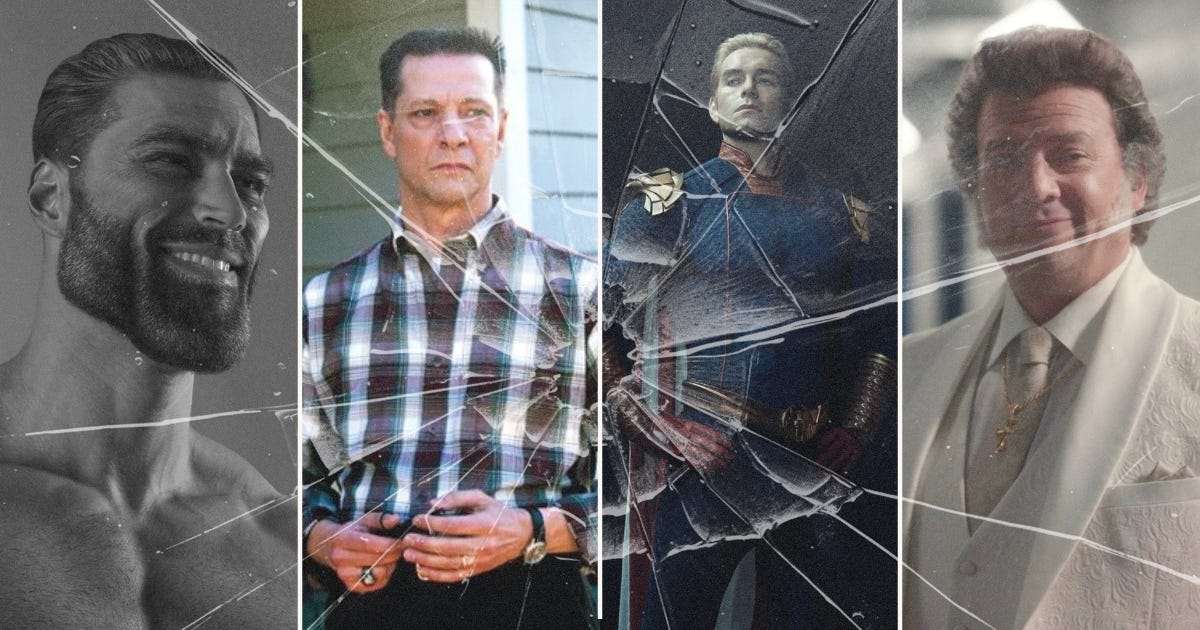
The Body: Looksmaxxing
It started on internet forums. Young men trading notes on how to optimize their appearance: skincare routines, jaw exercises, diet protocols, posture correction. It migrated to TikTok. It has a vocabulary now. Softmaxxing for the accessible end. Hardmaxxing for the extreme. Men pursuing surgical procedures, bone restructuring, irreversible modifications in pursuit of a particular aesthetic. The goal is something called a “Chad,” the alpha male ideal, rendered in bone structure and symmetry.
The term is looksmaxxing, and it would be easy to dismiss it as a fringe internet thing.
It is not a fringe internet thing.
This is a window into something much older and much more widespread: the man who has no stable interior, so he builds an exterior instead. The body becomes the project because there is no self underneath to return to. Hunt down every flaw. Eliminate every deviation. Make the body acceptable and desirable even if the person inside never feels like he is. Build something that looks like a strong man, because no one ever guided him into becoming one from the inside.
The gym is not the problem. Neither is the discipline, the diet, the deliberate care of a physical self. There is a version of physical practice that comes from genuine inhabitation, a man who is in his body, who has a felt relationship with himself.
This is different. This is the man who cannot stop scrutinizing and transforming his own face, because stopping would mean actually facing himself, and that is something he has never learned to do. The parts of him he cannot face don’t disappear. They go underground, and they steer his life unconsciously. What gets repressed never dissolves within us; it finds another form of expression. And in this case, the expression is in trying to perfect what is seen in the mirror.
The tragedy is that on the surface level, it works. Physiques improve, the glow-up is real, and people respond. The strategy gets reinforced: keep going, go harder, never stop. Meanwhile, the thing it’s compensating for never gets touched. Men are developing body dysmorphia chasing an aesthetic that was never going to give them what they were actually looking for.1
You cannot looksmaxx your way into feeling like you belong in your own life.
When there’s no internal sense of worth, the body becomes the project.
The Hidden Shadow: Sexual Fragmentation
If most people are being honest with themselves, this one is so much more prevalent than anyone will publicly acknowledge.
Jack Morin’s The Erotic Mind (1995) offers the clinical framework that desire that cannot be integrated doesn’t disappear, it finds another way out, often through condemnation. So the louder a man condemns something, the more you should wonder what that condemnation is covering up.
The man who presents one way to the world and lives something entirely different in his private life. The conservative “family values” public figure whose sex life would end his career. The loudest voices against certain desires often turn out to be the ones most consumed by them. This is one of the most consistent and documentable patterns in public life.2
Sexual desire doesn’t dissolve because a man or a culture decides it shouldn’t exist. What gets pushed underground shows up in compulsion, in secrecy, in behavior that feels split off from the rest of a man’s life, like it belongs to someone else entirely, like he can keep the two versions from ever meeting. But it comes out eventually.
Unintegrated desire leaves a man in pieces, managing the distance between who he says he is and what he actually needs.
The impact of this goes way beyond the bedroom. Men who cannot be honest about their own interior lives cannot lead with integrity. They cannot build relationships on truth. They cannot hold power without using it to protect the secret. The suppression doesn’t stay contained. It leaks into every room they walk into, every decision they make, every structure they build or defend.
And when enough men in positions of power are living this split, it stops being a personal problem. It becomes a cultural one.
The trail of pain and trauma that follows men operating from this place is often further reaching than any of us can fully track. This a tragedy, and points to an imperative to us all to be a source of safety and healing for those who have been wounded by these dynamics wherever we can.
The Performer: Manosphere / Political Masculinity
This is the one that’s been winning elections.
You know this archetype because he is everywhere and he is loud. He speaks in declarations. He doesn’t ask questions because questions imply uncertainty and uncertainty is weakness. He needs you to know he is in charge, that he has the answers, that strength is the only currency that matters and he has more of it than you. Dominance is not just a strategy for him, it is the air he breathes.
There is an entire industry built on selling this to men who are starving for structure. The manosphere. The podcast empires. The political movements dressed up as masculine restoration. What we need to understand is that the hunger they’re feeding is legitimate. Men do need initiation. Men do need something that asks more of them.
But what they have to offer is garbage.
What’s actually being sold is a costume.3 They model behaviors that signal power without requiring the interior work that authentic power demands. In these spaces, you don’t have to face yourself. You just have to be louder and more certain than the next man.
This has repercussions far beyond just men listening to podcasts.
These performers end up in office or helping to decide who ends up in office. They end up running companies, leading movements, shaping policy. Because the whole architecture is built to avoid challenge, institutions bend around their fragility. Complexity gets flattened, and anyone who asks a real question becomes a threat.
A man who has actually done the work of becoming himself does not need an audience to feel seen. He does not need enemies to feel strong.
So what we end up with is a world shaped by men who have learned how to access the performative power that is offered by status or roles, but never learned how to hold their personal power responsibly. Men who can speak with authority, build influence, lead movements, run companies, or dominate conversations, and still remain fundamentally unsteady underneath it all. They believe they’ve become the ideal of masculinity.
And when that performance gets a stadium and a microphone, the rest of us end up living inside the consequences.
The Rigid Believer: Patriarchal Religious Masculinity
This one wraps himself in God.
The hierarchy is clear. The roles are fixed. The rules are decided and they were decided before you were born, which is precisely the point. There is no ambiguity here, no complexity, no room for questions that don’t already have answers. Submit to the structure. The structure is divine. To question it is not just weakness. It is sin.
What no one has ever told them is that this rigid obedience to a morality crafted by Empire to seem Divine is not true faith. Faith requires active relationship, humility, curiosity, and sitting with the unknown.
What this is, is certainty used as armor. Men turn to a rigid external framework that stands in for the interior authority that they never had a chance to develop.
Men who need God to tell other people how to live cannot, in fact, trust themselves. Underneath the doctrine is a man who never learned to locate his own moral center, who never developed the capacity to sit with genuine discernment or hold complexity without it threatening everything. So he outsources it. To a text that has been translated, retranslated, edited, and curated by men in ways that reinforced obedience to it. To the denomination. To the leader above him who is also outsourcing it somewhere else.
This is not an accident of interpretation. The monotheistic traditions at their root carry a radical message that the divine is not a being above you issuing commands, but the ground of all being, the unified source in which everything is embedded. All-one. The mystics in every Abrahamic tradition know this: the Kabbalists, the Sufis, the Christian contemplatives. What the empires that hijacked these traditions needed was something very different, they need an authority figure in the sky, a cosmic king who mirrored earthly kings, a Father who demanded obedience the same way they did. So that is what the texts were translated and shaped to say.
The God of empire is a sky-daddy. Worship him, obey his representatives on earth, and you never have to grow up. A mature person with a living relationship to the sacred is ungovernable. A frightened child with an angry father overhead is not.
There is a question that men like this ask, usually rhetorically, that reveals what they themselves are missing:
“Without God or the threat of hell, what stops anyone from raping or murdering?”4
It sounds to them like a defense of morality, but it’s actually a confession of how horrifically under-developed they are.
A man with a mature interior life, a genuine moral center, a lived relationship with his own values doesn’t need divine prohibition to know that rape is wrong. It isn’t that hard to not want to hurt people when you have basic respect for yourself and others.
The question only makes sense if you’ve never developed yourself into a mature, grounded sense of self. If the only thing standing between you and causing harm is an external rule, then yes — losing the rule is terrifying. But that terror isn’t faith. It’s the absence of a self, and the harm happens anyway, just in the shadows.
Men like this leading religious communities are incredibly dangerous.
They lead from fear dressed as righteousness. They use doctrine to control women, to punish desire, to exclude and condemn anyone whose existence complicates their framework. Their cruelty gets sanctified, and anyone who challenges it isn’t just wrong, they are against God.
They can’t see that nothing about this is Godly.
This is a mass developmental failure with an army.
And the most tragic thing is that genuine faith, the kind that actually requires surrender, transformation, and self-examination, would threaten everything they’ve built. Which is why you won’t find much of it there.
Four interconnected archetypes. There is a core pattern underneath all of them.
Men tend to project “daddy issues” onto women without realizing that their entire life is constructed from their own daddy issues.
I don’t mean this as a punchline, but as a real and specific developmental gap: the absence of a grounded, accountable masculine presence at the stage when a boy was ready to learn what it means to hold power, feel deeply, and stand in reality-as-it-is without needing to control it.
When that presence is missing, the need doesn’t disappear. So men grasp for whatever seems like it will fulfill that gaping hole. They reach for perfecting the body, for the sex they publicly shame and secretly long for, for ideology that makes them feel strong and powerful, for certainty, for dominance.
These aren’t different types of men, and the men who express these archetypes are not the originators of this pattern, they were born into it. We were all born into it, this messed up world is our collective inheritance and therefore our collective responsibility.
With awareness, commitment, and both personal and collective effort, we can and must help change this pattern for future generations.
We Have What They Didn’t
Most of the men who raised the men who raised us were not withholding love, wisdom, mature guidance on purpose. They didn’t have it themselves. It goes back further than most of us can wrap our heads around.
It’s useful to take the view that so many indigenous communities operate from, and consider things from the perspective of seven generations: three back, three forward, and the one we are living in. These are the three generations that we actually have the potential to come into living contact with within one lifetime, and is a time-scale that we can actually conceive of effectively.
The “Greatest Generation” of our grandfathers were traumatized by war and didn’t speak of it. Suppression was how they kept moving. Boomers inherited that silence and built authority on top of it. Their fathering model was provision without connection, strength without the emotional range that makes strength safe to be around. What got passed down wasn’t necessarily malicious, but severe limitations presented as normalcy.
And most of them never had access to anything different. Therapy was considered a sign of weakness. The idea of a man sitting with his own inner life, examining his patterns, taking responsibility for his impact, was not just uncommon. It was unfathomable. They did not have the tools. They barely had the language.
We do. We are living in a moment of unprecedented access to the maps of human development, to the inner work that previous generations within dominant culture never knew existed. We can see the patterns now. We can name them. We can trace where they come from and understand what they cost us and our parents. We can choose something different for our children, and maybe even for our peers.
That is the privilege of standing on the shoulders of our ancestors.
Not to look down at them, but to see further.
And the cost of not using that privilege is visible everywhere. How many people do you know who are in relationships that stay tense and shallow because nobody in them knows how to be honest without it rocking the boat? How many of us have been frustrated by the leadership of a man at the top who confused control with competence?
It is inexcusable that children will continue to grow up inside the same unexamined patterns, inheriting the same adaptive strategies, reaching for the same substitutions their fathers did.
The harm reproduces itself until someone decides to stop reproducing it.
That is what maturation actually is. It is the willingness to keep developing your entire life. Maturation requires that you stop managing your image and start building your character.
Long before I became a father, I began playing with the “Daddy” archetype. I’d ask myself what that version of myself would do in a challenging situation.
“Daddy” here is about coming from grounded presence and emotional steadiness.
The capacity to hold intensity, yours or someone else’s, without collapsing or forcing it down. The quality of attention that communicates: I can feel what’s happening here and I’m not checking out.
Most men never had this modeled so they never learned to become it. But the need to become something greater than the scared and lonely child inside of them goes looking, and finds the manosphere and the mirror and the doctrine and the shadow. It finds every substitution this essay has walked through.
We need to embody, and model, maturation. Actual, continuing, humble maturation. Available to any man willing to stop outsourcing his interior life and start taking responsibility for it. Available to anyone who has been living inside these patterns and is finally ready to name them.
If you see yourself in these archetypes, I want you to know that this is not your fault. The generation that shaped you was shaped by the one before it, and that one before it, all the way back through silences and wars and survival and unexamined pain.
It becomes your responsibility the moment you can see it.
We can see it now.
We don’t need more performances of masculinity. We need men who have actually done the work of becoming themselves. Men who can be present, honest, accountable, and steady.
At some point someone has to grow up and stop passing it on. We are that someone. For the first time in a long time, we actually have what it takes to do it.
🖖✨🐌,
Seth!
This is the work I’ve dedicated my life to, and it’s always evolving. If you want to take some next steps in your own development, for the sake of collective evolution, here are some opportunities to go deeper:
For those interested in developing Spiritual and Relational Maturity, we are offering a 3-Week Workshop series at The Thread Interfaith Seminary called The Practice of Sacred Relationship. We begin this Wednesday, April 15th, and will be gifting $120 credit to those who join us that can be applied to either of the courses listed below. Learn more and join us here.
We are now enrolling our annual Summer Course, Sex, G✧d, & Money which supports steadily unfolding clarity, growth, and empowerment in each of these three powerful forces in our lives. Enrollment is open through May 18th, those who enroll before April 23 will receive 3 free coaching sessions to support your process.
For those seeking to heal your relationship with your sexuality, our course the EDGE offers a methodical 6-phase process to become your own somatic sexual healer, learning skills that you can bring to your partner(s) after you have cultivated them within yourself. Enroll any time and move at the pace of your nervous system.
These archetypes, and the work of ongoing maturity comes directly from my 1:1 client work in which I have been entrusted to support many people, including many young men with their deepest shames and truest potentials. If you or someone you know might benefit from this kind of coaching or mentorship, I would be happy to connect. Reach out here.
Maxwell Maltz, author of the massively influential Psycho-Cybernetics published in 1960 is a perfect authority on this dynamic, though he died nearly 50 years before the term Looksmaxxing was coined. Maltz was a plastic surgeon who helped people make the physical changes to their bodies that they either needed or desired. He consistently observed patterns in the people who actually found fulfillment and those who continued as miserably as ever, no matter what physically changed. By matching his observations with the systems-steering framework of Cybernetics (coined by Norbert Weiner and originally inspired by the autonomic nervous system), he developed an incredibly effective system for shaping and steering one’s life from the inside out. Psycho-Cybernetics has been the (often uncredited) basis of a tremendous amount of self-help, manifestation, and personal development work ever since. The work that my wife Rev. Ganga Devi Braun and I guide our clients and students through takes this further in a more embodied and embedded way, with what we call Eco-Somatic Cybernetics. This is the animating philosophy of everything we teach within the EMUNAH ΛCΛDEMY of Multidimensional Living.
The pattern has been documented in laboratory settings as well as public life. A landmark 1996 study by Adams, Wright, and Lohr in the Journal of Abnormal Psychology found that men who scored highest on homophobia scales showed significantly greater physiological arousal to gay pornography than non-homophobic men, though they self-reported less.
The public record confirms this at scale, and it isn’t only about same-sex desire. Former Speaker of the House Dennis Hastert built a career on family values while sexually abusing teenage boys. Megachurch founder Ted Haggard preached against homosexuality while paying a male escort for sex. Florida GOP chair Christian Ziegler was investigated for rape while his wife co-authored the “Don’t Say Gay” bill. And as this essay was being written, Kristi Noem’s husband Bryon was revealed to have been pursuing gender exploration through bimbofication, expressing, “I want to be a woman so bad” to sex workers. This is the spouse of a politician who banned gender-affirming care for minors, who has been central to an administration that has scapegoated and harmed the trans community relentlessly.
And, well, time will tell about Lindsay Graham.
I wrote about this more extensively, including how this shows up within “conscious“ and ”spiritual” men’s work here:
This is a real, and repeated conversation I have had with many of my clients over the years. From my research, it seems that the general sentiment stems from things that Dennis Prager has said and written over the years.
The four horsemen of the apocalypse were preceded by these men.
Most women are subconsciously aware of these types, but I've yet to see them succinctly outlined. Thank you for this. More than ever, men need strong, self-integrated role models.
The clearest presentation of this crisis I have yet read. Rites of initiation are critical, and when civilizational, the potential for failure and death quite real.