


We are exhausted, overwhelmed, and desperate for change, and almost no one understands why.
We are living in a time when people want revolution everywhere except inside themselves. We want to change governments, economies, systems, and futures, while remaining almost completely disconnected from their own bodies. There is a dangerous gap between how urgently people want change and how little they know how to feel themselves. The crisis of our time is not only political, ecological, or economic. It is physiological.
We are trying to change everything outside us while having almost no relationship with what is happening inside us.
Most of us were never taught how to feel ourselves, not in any sustained or practical way. So we keep searching, learning, striving, fixing, hoping something will finally shift. But the place where change actually happens was never invited into the conversation.
It shows up as exhaustion that rest does not fix, as frustration that does not have clear language, as a low-grade anxiety that feels both personal and collective at the same time.
People often describe this as stress, burnout, or overwhelm, but those words barely touch what is happening. What is really being carried is unprocessed experience. Not just personal history, but the weight of the world we are living inside. Ecological grief. Political instability. Economic pressure. Relational strain. Generational trauma. Chronic uncertainty. All of it moving through nervous systems that were never taught how to metabolize this much intensity.
So the body adapts in the only ways it knows how. It braces. It numbs. It speeds up. It disconnects. It narrows attention. It suppresses sensation. Over time, these adaptations start to feel like personality, identity, or “just the way I am,” even though they began as intelligent survival responses to protect the true nature of who we really are.
This is why so many people are doing everything they know how to do and still feel off inside. It is not because they lack insight, effort, or commitment. It is because their bodies are carrying more than they were ever meant to carry alone.
If any of this feels familiar, it makes sense. Many of the people I work with are thoughtful, well-intended, and deeply committed to growth. They have read the books, gone to therapy, reflected, practiced, questioned, and tried again. And still, beneath all of that effort, something remains unresolved.
At some point a quiet question begins to surface, even if it is never spoken out loud: why does this still feel so hard, and why do the same patterns keep returning?
This is where so many people turn that question inward and assume something is wrong with them. That they are missing something. That they are not doing enough. That they are somehow failing at the work of being human.
They are not.
The missing piece is not more information, more insight, or more discipline. The missing piece is that almost all of our models of change have been working around the body instead of with it. The mind can understand and the will can try, but the body is the system that actually carries the pattern. Until the body is included, lasting change cannot stabilize.
This is why so many people can see clearly what needs to change and still feel unable to live differently. It is not because they lack awareness or commitment. It is because the system that runs their energy, attention, and behavior has not yet been given the conditions to reorganize.
Nothing is wrong with you. Your body has simply been left out of the conversation.
Why So Much Effort Has Led to So Little Change
What has been missing is not effort, intention, or intelligence. What has been missing is a basic form of bodily literacy that most of us were never taught.
Every moment of your life, your body is generating information. Signals about safety, stress, energy, hunger, fatigue, desire, connection, and threat are constantly moving through your nervous system. Long before you form a thought or make a decision, your body has already oriented toward the world in a particular way. This internal sensing is not abstract. It is the foundation of how perception, emotion, behavior, and meaning are formed.
There is a name for this capacity: interoception.
Interoception is the nervous system’s ability to detect and interpret what is happening inside the body.
It is how your system knows when you are settled or overwhelmed, open or braced, nourished or depleted. It is deeply linked to emotional life, decision-making, resilience, sexual responsiveness, attachment, and the ability to recover from stress. When interoception is clear, the system receives accurate information. When it is blunted or chaotic, the system loses its internal compass.
Modern life quietly erodes this capacity.
Chronic stress narrows perception. The speed of our days overrides sensation. Distractions pull attention away from the body. Over time, most of us lose access to the subtle signals our bodies generate, signals that serve to guide us, but cannot when they are overridden by the pressures, pacing, and demands of modern life.
There are risks that come when we stop noticing early signs of fatigue, overwhelm, misalignment, or desire. Crisis is often detected too late.
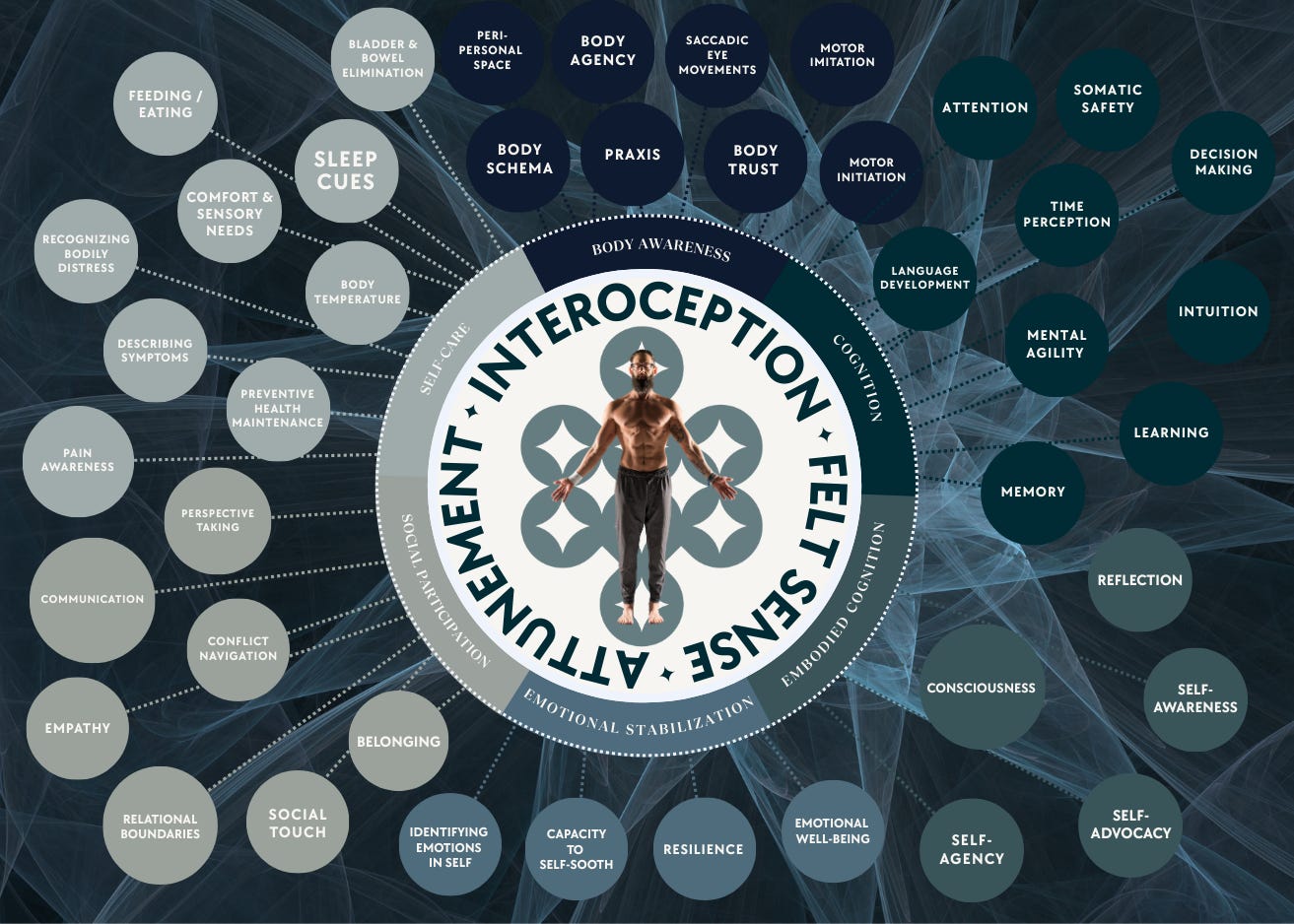
Sensing the signals of our bodies is vitally important. But sensing alone is not enough.
What matters just as much is whether you can feel those signals clearly and stay with them with enough presence to integrate what they tell you into your lived experience.
This is what is possible when we cultivate our felt sense.
Felt sense is the direct, pre-verbal experience of what is happening in the body.
It is not the story you tell about how you feel, and not the label you give to an emotion, but the actual texture of experience itself. The tightness in your chest. The heaviness behind your eyes. The warmth in your belly. The subtle hum of energy or the dull ache of exhaustion. Felt sense is where the body becomes knowable from the inside.
Most people have been taught to bypass this layer. They move immediately from sensation to interpretation, from experience to explanation. They analyze what is happening instead of inhabiting it. As a result, the nervous system never receives the full message of its own signals. The data arrives, but it is not integrated.
This is where attunement becomes essential.
Attunement is the capacity to stay present with sensation long enough, and with enough steadiness and care, for the nervous system to reorganize itself.
It is not about fixing, forcing, or overriding what you feel. It is about creating the internal conditions in which the body can complete the patterns it has been holding.
When attunement is present, the system does not have to escalate its signals to be heard. Tension can soften before it becomes pain. Stress can resolve before it becomes collapse. Emotion can move before it becomes shutdown or explosion. Over time, this changes everything about how a person lives inside themselves.
These three capacities form a living circuit: interoception provides the signal, felt sense gives it lived meaning, and attunement allows the system to reorganize in response. When this circuit is intact, the body regains its natural intelligence. When it is disrupted, people become increasingly disconnected from themselves, even as they accumulate more knowledge about what they “should” be doing.
This is why so many approaches to healing, therapy, and personal growth stall. Insight happens in the mind, but change happens in the nervous system. Without this bodily literacy, people can understand their patterns perfectly and still repeat them. They can see what needs to change and feel unable to live differently. They can do years of work and still feel as though something essential has not shifted.
It is not because they are failing.
It is because the body was never given the conditions it needs to change.
When interoception sharpens, when felt sense returns, and when attunement becomes a lived skill, something profound begins to happen. Stress is recognized earlier. Boundaries emerge more naturally. Desire becomes clearer. Sexual energy organizes more coherently. Emotional responses soften without suppression. Recovery becomes more efficient. Choice becomes available again.
Not because the person is trying harder, but because their system finally has accurate information and the capacity to respond.
This is the missing foundation beneath almost every form of change we attempt, both personally and collectively. Without it, we continue to chase solutions that cannot reach the source of the pattern. With it, the same tools and insights begin to work differently, because the infrastructure supporting them has finally come online.
When we zoom out, what we are facing is not just a collection of personal struggles. It is a cultural and civilizational one. We are living inside a convergence of breakdowns: ecological instability, political volatility, economic fragility, social fragmentation, and technological acceleration that far outpaces our capacity to integrate its effects.
Many people feel this, even if they do not yet have language for it. There is a pervasive sense that the ground is shifting, that something fundamental is no longer stable, that the old ways of living are no longer sufficient for what this moment is asking of us.
What is rarely acknowledged is that all of this is happening inside human bodies.
The erosion of internal signal clarity does not just make us tired or stressed. It erodes agency. When you cannot feel your own system clearly, choice becomes constrained. You second-guess yourself. You hesitate. You react instead of respond. Intimacy suffers as well, because connection requires the capacity to sense yourself and another at the same time. Without that, relationships become brittle, transactional, or performative. Stability crumbles, both internally and collectively, because nervous systems that cannot settle do not cooperate well, and societies that depend on dysregulated bodies will always fracture.
This is why so many of our attempts to address the crises of our time feel incomplete. We debate policies, protest in the streets, and generate endless commentary, while the physiological foundation beneath those efforts continues to degrade. We are trying to solve structural problems without tending to the living human infrastructure that must actually live inside the solutions.
And yet, there is a deeper truth here that is both sobering and hopeful: most people actually already know enough.
We are not stuck because we lack information. We are overwhelmed because our systems cannot integrate the information we already have. We are not waiting for better ideas. We are waiting for coherence. We are primed for our inner worlds to begin working as a whole again.
What we need now is a different kind of foundation for change. This is the very essence of what we are creating at EMUNAH ΛCΛDEMY. Not with more concepts to memorize, but with the missing connective tissue: the living fascia that allows insight, emotion, sensation, and action to finally organize into something stable and usable.
When coherence returns, life begins to feel different from the inside. Capacity expands. You have more room to meet stress without collapsing or hardening. Intimacy deepens, because you can stay present with yourself and another without losing your footing. Steadiness grows, not as numbness, but as the felt sense of being able to remain here even when things are intense. Agency becomes embodied rather than aspirational. Aliveness returns, not as a spike of excitement, but as a quiet, regenerative current that runs through daily life.
Rather than transforming into a new version of yourself, this is about recovering what your system has always been capable of when given the conditions it needs to function well, authentically, as you.
What remains is the question of how this becomes lived.
Understanding these ideas is meaningful. Feeling them is transformative. But what actually changes a life is sustained practice inside an environment that supports the body in doing this work over time.
This is why we have created BeginWithin.
BeginWithin is not a course in the conventional sense, and it is not a collection of techniques. It is a year-long living environment designed to help your nervous system stabilize, reorganize, and expand its capacity through steady, embodied practice. It is where the insights you already carry begin to move out of your head and into your body, your relationships, your choices, and your daily life.
Inside BeginWithin, you will learn how to work directly with interoception, felt sense, and attunement through guided practices, embodied frameworks, and ongoing support. They develop the capacity to stay present with experience, to meet stress without collapse, to relate more honestly and tenderly, and to recover their natural aliveness without burning out or hardening.
This is not about self-improvement as if there is something faulty with you. It is about reclaiming the conditions your system needs to thrive in the world as it is.
If this essay is naming something you have been carrying for a long time, and if a quieter part of you recognizes that what you are longing for is not another idea but a different way of living inside yourself, we invite you to explore joining the BeginWithin experiment with us this year.
We call it an experiment intentionally, not because the work is untested — the frameworks, practices, and ways of living we share inside it have been shaped through years of real life, real bodies, real relationships, real coaching, and real integration.
What excites us the most is our curiosity about what happens when people who are ready for this level of depth, honesty, and embodiment come together and begin living it, both alongside one another and in ways that ripple out into the relationships, communities, and ecosystems to which they belong.
BeginWithin is not a course to complete.
It is an environment to inhabit to shape your 2026 all the way through.
We are creating a living space where living wisdom becomes woven into your daily life, relationships, creativity, leadership, and the way you meet the world.
We believe that what emerges from that collective field will matter far beyond any one program, brand, or methodology. We believe this is how real cultural change begins, not through louder ideas, but through interconnected networks of people whose nervous systems, bodies, and lives have become coherent enough to carry what this moment is asking of us.
I’ll say it again:
This is not about self-improvement.
It is about reclaiming the conditions your system needs to thrive in the world as it is.
If you feel the quiet pull of that, you already know where this begins.
Wow!!!! This is a LONG article, rich with insights….an EXCELLENT description of how our bodies perceive information …. and why/how we feel stuck, stressed and overwhelmed.
Nicely explained and your emphasis on integration is such an important piece that often gets overlooked.